

What Are Vertical Carousels and Paternoster Systems?
Anyone involved in warehouse automation will also be familiar with this group of storage systems – among the oldest developments in the field: the various types of storage lifts. The terminology in this segment can be confusing. There is the vertical lift module (VLM), the carousel rack or carousel storage system (also called a rotary rack), the paternoster rack, tray storage, the storage tower (or tower warehouse), the rotary storage system, and the officially designated Vertical Lift Module (VLM). Colloquially, these are sometimes referred to as “Megamats” (derived from a product name used by manufacturer Kardex). For anyone who seriously wishes to engage with the topic of innovation in logistics, familiarity with these terms is essential.
The History of Paternoster Rack Systems:
As early as 1876, the first paternoster lift for goods transport was in operation in London. While it was only a small step from there to utilising this new technology as an automated storage system, the development took time and was primarily driven forward in the USA after World War II, before the first vertical lift modules and carousel storage systems came to market in Europe during the 1960s.
How Does a Storage Lift Work?
Two fundamental operating principles are distinguished in this segment:
The storage lift principle and the paternoster principle (see illustration).
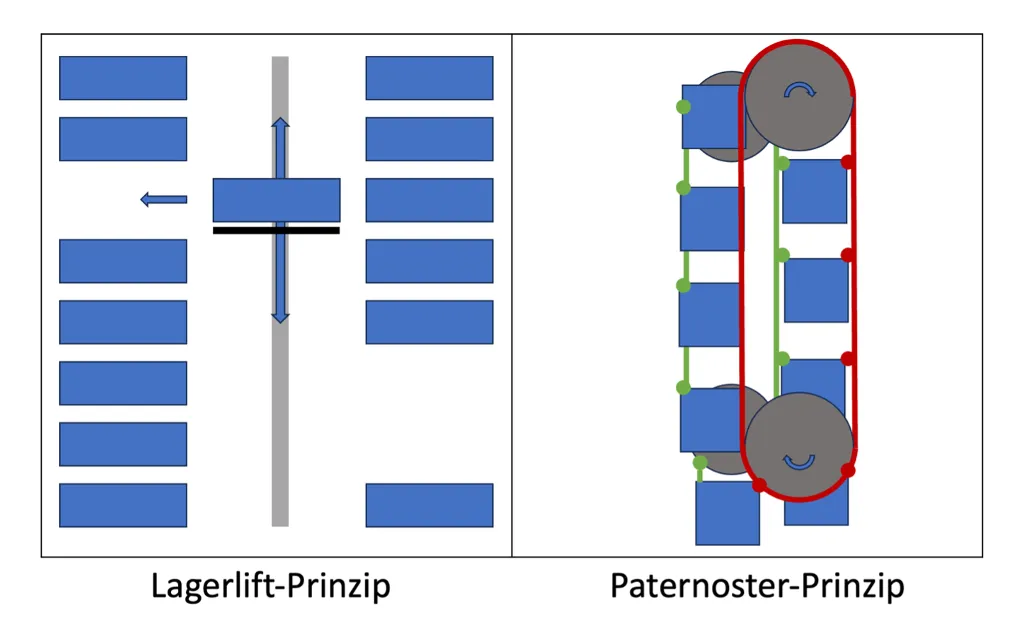
How the Storage Lift Principle Works:
The storage lift is essentially a vertical lift. Goods are stored on trays and introduced into or retrieved from the system at a single entry/exit point. This section is therefore not available for storage. This type of system can be built to very considerable heights (up to 30 metres is quite common); however, a central aisle must be kept clear between the front and rear rows of storage to allow the vertical movement of the trays. This means it is always an aisle-based system with a corresponding loss of floor area, which can be compensated for by building upward.
How the Paternoster Principle Works:
As the name suggests, goods on trays travel downward on one side – strung together like a chain – and back up on the opposite side, much like a paternoster lift (whose name is derived from a rosary bead chain – “Pater Noster”, meaning “Our Father”). Unlike the storage lift, this design does not require a central aisle; however, it does need space at the top and bottom for the trays to rotate, while the trays themselves always remain horizontal. A further characteristic of this design is the so-called “counterbalance load” (Unlast): care must be taken to ensure that the load on opposing trays does not create excessive weight differences, which could lead to motor overload.
Both systems are technically implemented using toothed belt drives, chain drives, or rack-and-pinion drives.
A Selection of Storage Lift Manufacturers:
-
Kardex (Megamat)
-
SSI SCHÄFER
-
Hänel
-
Modula
-
Dexion
-
ElectroClass
-
Systeo Industrie
-
Vidir
What Are the Advantages of Storage Lifts?
In addition to the specific characteristics of each design principle mentioned above, the automation modules of storage lifts are distinguished by the following advantages:
Due to the cross-industry applicability of these modules, they can be offered at competitive prices.
Space savings: By storing products vertically, the available space is utilised very effectively. This results in higher storage capacity within a limited footprint.
The goods-to-person system reduces travel distances within the warehouse.
Error reduction: Automating warehouse operations and the precise control of the lift minimises human error. This leads to improved inventory management and a reduction in losses.
What Advantages Does the NOYES System Offer Compared to a Paternoster?
In addition to the benefits of short travel distances, space-saving storage, low investment costs, and error reduction, the NOYES system is distinguished by a far greater degree of modularity and flexibility. While lift systems are typically regarded as fixed installations for 20 to 30 years in logistics halls and factories, the NOYES system can be dismantled and reassembled at a different location within a single day.
Added to this is the emergency concept and redundancy offered by the multiple NOYES bots compared to the single drive (single point of failure) found in vertical lift modules (VLMs). In the event of a robot failure in the NOYES system, it can be replaced by the operating staff themselves. This makes the NOYES system extremely resilient against any type of disruption, with no need to wait for a service technician.
Conclusion
Storage lifts offer a cost-effective option for warehouse automation in specific use cases, and in these applications they demonstrate comparatively good space utilisation. However, this primarily requires very high ceiling heights (>5 m). In environments below this threshold – and wherever low downtime, easy accessibility of goods, and high flexibility are required – the NOYES system represents an excellent alternative.