

Warehouse management systems for mid-sized companies: which alternative fits your warehouse?
If you are searching for warehouse management systems, inventory management software or WMS alternatives for a mid-sized company, the market can quickly become hard to compare. Large WMS vendors such as SAP EWM, Manhattan, Blue Yonder or Körber can be very powerful for complex logistics networks. But for many mid-sized companies, they are not automatically the best first step: the more relevant need is often a pragmatic start, manageable IT effort, better stock transparency and faster operational relief in the warehouse.
Often, the real question is simpler:
Do you only need better software for stock and orders, or should the physical warehouse process improve as well?
Quick decision
- Only need transparency? Inventory software, ERP inventory modules or open source warehouse software may be enough.
- Need flexible WMS processes? Modern API-ready systems such as Pyck are worth a closer look.
- Struggling with search time, walking distance or limited space? Automation should be part of the decision, not just software.
This comparison looks at three alternatives for mid-sized companies:
The focus is on warehouse management systems that bring enough structure for daily operations without turning the first step into a heavy enterprise project.
| Alternative | Works especially well if ... | Less suitable if ... |
|---|---|---|
| Open source warehouse software | You want to reduce cost and vendor lock-in and have internal IT or implementation know-how. | You expect a fully supported standard operation without an internal project team. |
| Pyck | You are looking for a flexible, API-ready WMS and want to keep developing processes individually. | You mainly need physical automation for walking distances and picking. |
| NoyesStorage | You want to combine WMS functionality directly with automation, stock transparency and faster picking. | You only need a pure WMS without hardware or automation. |
Start the 90-second check: does NoyesStorage fit your warehouse?
Inventory management software, warehouse software or WMS?
These terms are often used interchangeably, but they do not always mean the same thing.
Tracks stock, items, storage locations and inventory counts. For simple warehouses, tool issue areas or small spare-parts inventories, this can be enough.
Usually goes further: inbound goods, storage locations, transfers, reservations, picking, shipping preparation and returns.
Controls warehouse operations: where is the item, which order has priority, how should it be picked, and what is the next useful movement?
For mid-sized companies, this distinction matters. A tool that is too small leaves manual workarounds in place. A WMS that is too large adds project complexity, integration effort and ongoing maintenance before the first pick becomes faster.
Why large warehouse management systems are not always the best starting point
Enterprise WMS platforms are built for demanding warehouses: multiple sites, high order volumes, complex automation, many interfaces, international rollouts and deep process logic. That is their strength.
For smaller and mid-sized companies, this strength can also become a hurdle. Typical issues include:
- longer selection and implementation projects
- higher requirements for master data, process definition and IT resources
- license, consulting and integration costs beyond the software price
- more functionality than the warehouse really uses in the first step
- a business case that only works at higher volumes
This does not mean large WMS platforms are wrong. If your warehouse is growing strongly, connects several sites or already runs a complex automation landscape, they belong on the shortlist. If you are looking for stock transparency, fewer search times and a pragmatic starting point, the following alternatives are worth considering.
Alternative 1: open source warehouse software
Open source sounds attractive for many teams: no classic license fees, access to the source code, more control over data and processes. In practice, open source is not the same as a free WMS without effort. Costs often move from license to implementation, hosting, customization, maintenance, updates, support and internal responsibility.
Still, open source can be a very good option, especially if you consciously want to stay independent and have technical competence in-house or through an implementation partner.
Examples of open source systems
Odoo Inventory is interesting when warehouse management should be part of a broader ERP setup. Odoo positions its Inventory app with features for stock, routes, replenishment and real-time transparency. This can fit companies that are not only looking for a WMS, but for integrated business software.
ERPNext is a fully open-source ERP system with modules for purchasing, sales, inventory and order handling. It can be compelling if you want to bring inventory, ERP and operations closer together. The key question is not only “Can the software do it?”, but “Who will implement it properly and operate it long term?”
OpenBoxes has a strong background in supply chain and healthcare logistics. The system focuses on inventory management, multi-facility visibility, batches and expiration dates. It can fit mid-sized warehouses with similar requirements. For e-commerce fulfillment or highly optimized picking, the fit should be checked carefully.
OpenWMS and myWMS are more technical WMS or framework approaches. They may be interesting for engineering-led teams or integrators, but they are rarely the easiest path for a mid-sized company without its own software team.
When open source fits well
Open source warehouse software fits well if you:
- have internal IT or implementation expertise
- want to model processes individually
- want to reduce vendor lock-in
- consciously manage hosting, updates and security yourself
- can plan enough time for selection, customization and testing
It fits less well if you need a system that runs productively without project work. In warehouse logistics, success depends less on downloading software and more on master data quality, barcode logic, storage location logic, training and clean integration with purchasing, sales, ERP or shop systems.
Alternative 2: Pyck as a flexible WMS
Pyck is an interesting WMS alternative from Germany because the provider thinks about warehouse management software in an open, flexible and API-oriented way. Pyck describes itself as an open-source warehouse management framework for the AI-driven era. Its offering includes Pyck Cloud WMS, Pyck Framework, Pyck Go and Pyck Studio.
For mid-sized companies, the direction is especially relevant: away from rigid standard processes and toward adaptable workflows, open interfaces and stronger control over your own warehouse logic. Pyck Cloud WMS is described as an open-source-based cloud WMS with a public API for integrations into ERP, e-commerce and third-party systems. Self-hosting is also mentioned as an option.
The AI component is mainly relevant where processes should be modeled faster, workflows generated more easily, or individual WMS interfaces developed with less friction. Pyck does not position this logic as a small AI layer on top of an old system, but as a foundation for flexible, machine-readable processes.
When Pyck fits well
Pyck can fit well if you:
- are looking for a modern, flexible WMS
- need API integrations with ERP, shop or other systems
- want to map individual processes
- value open-source proximity and lower vendor lock-in
- are ready to introduce a still young system properly with the vendor or an implementation partner
Important to state clearly: Pyck is not warehouse automation in the sense of a physical goods-to-person system. It can improve software processes and integration logic, but it does not automatically reduce walking distances, shelf space or manual picking work. If that is where the pain is, automation should be considered as well.
Alternative 3: NoyesStorage with integrated WMS
NoyesStorage is not pure WMS software. It is a complete solution for automated small-parts warehouses. The system combines the shelving system, NoyesBots, user interface, inventory management and integrated warehouse management functions.
That makes NoyesStorage relevant for a specific search intent: many companies look for warehouse management systems because the warehouse has become unclear. In practice, the problem is often not only software, but search time, walking distance, full shelves, picking errors, limited space and fluctuating picking performance.
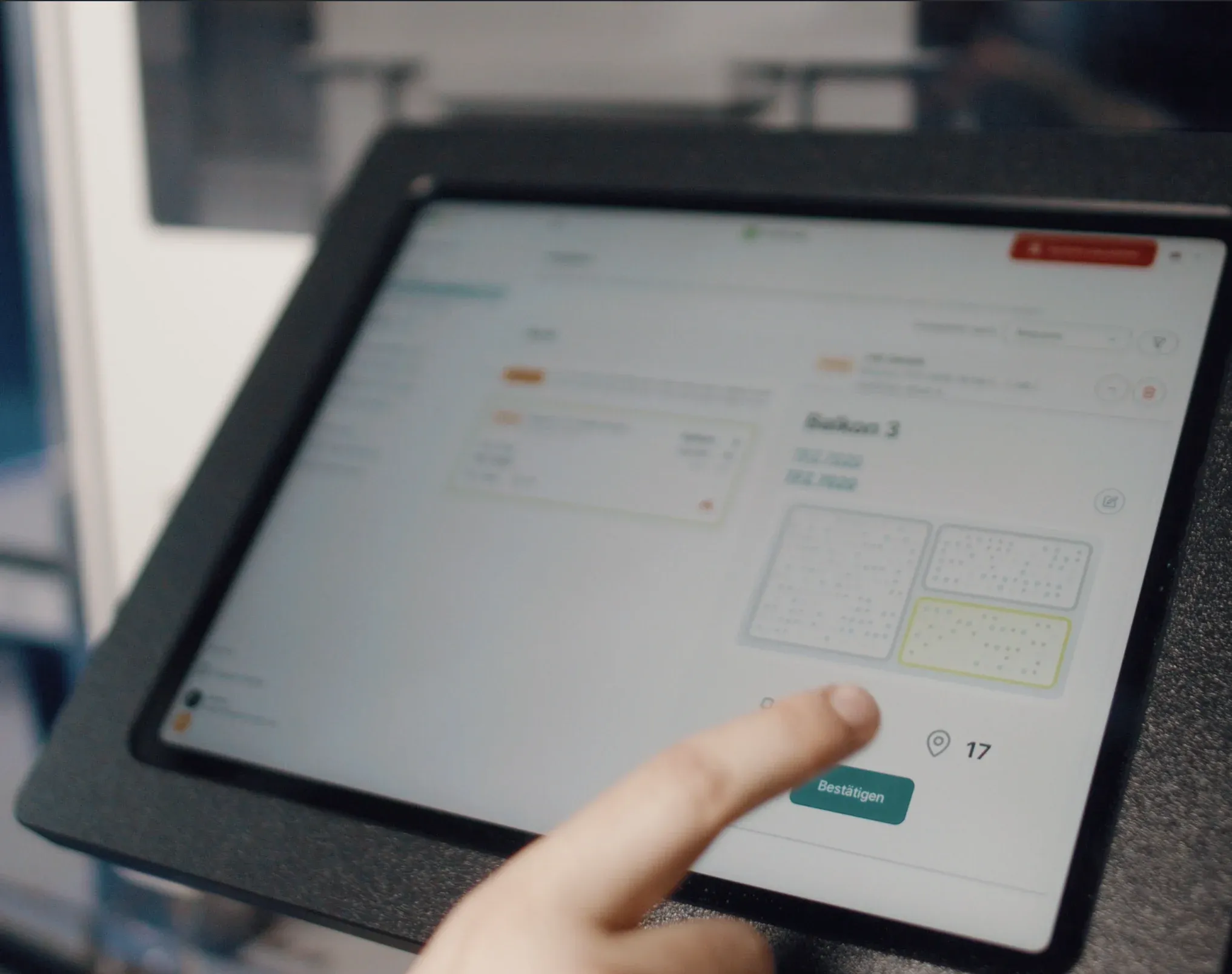
NoyesStorage approaches this differently. If you decide to automate with NoyesStorage, the integrated WMS software is included as part of the solution without a separate WMS license. The system can be operated stand-alone via app and directly covers key warehouse processes: SKU master data, inventory view, storage, retrieval, picking orders and request history. In addition, a REST API is available to connect order data, ERP synchronizations or other systems.
This is intentionally flexible: if you later decide to use another WMS, or if you already have an existing system in the company, NoyesStorage can be integrated through interfaces. The integrated software makes it easier to get started, but it does not rule out an external WMS or ERP connection.
The difference to a pure WMS: NoyesStorage does not only manage where goods are located. NoyesBots bring goods automatically to the picking station. This means the system can improve stock transparency, storage density and the picking process at the same time.
When NoyesStorage fits well
NoyesStorage fits especially well if you:
- want to automate a small or mid-sized small-parts warehouse
- want to improve stock transparency and picking performance at the same time
- need fewer search times and walking routes
- want to use warehouse space more efficiently
- want to start without a large enterprise WMS project
- want to use integrated WMS functionality without a separate WMS license
- want to keep the option open to connect another WMS or ERP system later
- want to connect ERP, shop or existing systems via interface
Depending on layout and process, NoyesStorage can enable more than 300 picks per hour per picker. With multi-deep storage, storage capacity can increase significantly compared with conventional shelving. The technical documentation cites up to 71% more storage capacity in one configuration compared with conventional shelving.
possible picks per hour per picker
more storage capacity in one example configuration
available for ERP, shop or system integrations
At the same time, if you really only need inventory management software for manual stock, NoyesStorage will likely be too much. In that case, open source, a specialized WMS or a tool such as Pyck may be more appropriate. NoyesStorage is most relevant when the WMS question is part of a larger operational problem.
Comparison: which WMS alternative is right?
| Criterion | Open source warehouse software | Pyck | NoyesStorage |
|---|---|---|---|
| Main benefit | Control, adaptability, lower license dependency | Flexible WMS with API and AI-adjacent process logic | Integrated WMS software plus automated storage and picking |
| Physical automation | No, only with additional technology | No, focus on software | Yes, goods-to-person with NoyesBots |
| IT effort | Medium to high, depending on the system | Medium, depending on implementation and integrations | Low to medium, stand-alone possible, integration optional |
| Good for | IT-strong companies, individual processes, cost control | flexible WMS projects, e-commerce, 3PL, individual workflows | small-parts warehouses, spare parts, e-commerce, production, compact spaces |
| Limit | Operation and support remain more strongly with you | young system, fit and maturity should be checked | not meaningful if only software without automation is needed |
| Next sensible step | Pilot installation and process mapping | Demo or WMS health check | Check warehouse data in the configurator |
Rough cost orientation: license is only one part
For a first shortlist, a simple cost logic helps. Important: do not compare only the software price. With warehouse management systems, real costs usually come from implementation, master data, interfaces, barcode or scanner processes, training, hosting, support and internal project time.
| Alternative | Rough cost logic | What to watch |
|---|---|---|
| Open source warehouse software | The software license can be very low or free. ERPNext, for example, is open source; Frappe mentions managed hosting starting at a few US dollars per month. Odoo has public pricing plans depending on setup. | The larger block is often implementation: process design, master data, customization, updates, hosting, security and support. Without internal know-how, costs shift toward service providers. |
| Pyck | Pyck does not publish a standard price list. According to Pyck Cloud WMS, the offering is currently in a beta phase with selected partner projects; pricing is shared on a project basis. | Process scope, integrations, custom workflows and hosting model matter. Pyck can be interesting if flexible WMS development would otherwise be expensive or slow. |
| NoyesStorage | Higher initial investment than pure software, because integrated WMS software, shelving, NoyesBots and physical automation come together. When choosing NoyesStorage, the WMS software is provided without a separate WMS license. Noyes material mentions an entry point from 55,000 euros and a RaaS model. | Consider NoyesStorage as a complete solution: WMS functions, inventory transparency, goods-to-person process, better space utilization and faster picking work together. The relevant comparison is the operational business case, not a single software license. |
As a rule of thumb: if you only want to digitize stock, start with software costs and implementation effort. If the real costs in the warehouse come from searching, walking, picking errors or limited space, the calculation should include these operational levers as well.
Decision guide for mid-sized companies
If you are comparing warehouse management systems, do not start with a feature list. Start with the problem.
Check inventory management software, ERP inventory modules or open source systems such as Odoo, ERPNext or OpenBoxes.
Check Pyck or another modern WMS with strong interfaces.
Check NoyesStorage, because a pure WMS does not automatically reduce the physical work.
Enterprise WMS vendors should stay on the shortlist.
A good decision is not created by choosing the system with the most features. It is created when effort, process maturity, warehouse size and business case fit together.
Conclusion: clarify the problem first, then choose the WMS
Warehouse management systems are not an end in themselves. They should make stock visible, make orders controllable and make everyday warehouse work easier.
For many mid-sized companies, three paths are especially interesting:
- Open source, if control and adaptability matter more than a ready-made full-service package.
- Pyck, if a flexible, modern WMS with API and AI-adjacent process logic is needed.
- NoyesStorage, if the WMS question is really connected to automation, space and picking performance.
If you want to find out whether your warehouse is primarily a software problem or an automation problem, the quickest entry point is the NoyesStorage configurator. It helps classify warehouse size, item structure and process fit without starting a large project right away.
Frequently asked questions about warehouse management systems
What is the difference between inventory management software and a WMS?
Inventory management software mainly focuses on items, stock, storage locations and stocktaking. A WMS additionally controls operational warehouse processes such as inbound goods, storage, picking, replenishment, shipping and feedback to ERP or shop systems.
Is open source WMS really free?
The software can be license-free or free to use, but the overall project is not automatically free. Hosting, setup, customization, updates, support, training, interfaces and internal responsibility must be planned.
Which open source warehouse software is suitable for mid-sized companies?
That depends strongly on the process. Odoo and ERPNext are interesting when warehouse management should be part of a broader ERP setup. OpenBoxes is suitable especially for inventory and supply chain visibility. OpenWMS or myWMS are more technical options for teams with integration and development know-how.
Is Pyck an alternative to traditional WMS vendors?
Yes, Pyck can be an alternative if you are looking for a flexible, API-oriented WMS. The approach is especially interesting for companies that want to map individual workflows. As with any young system, functionality, maturity, hosting, support and integration effort should be checked in the specific project.
When is NoyesStorage more useful than a pure WMS?
NoyesStorage is useful when not only digital stock, but also physical warehouse processes should improve. Typical triggers are full shelves, long walking routes, search time, picking errors, limited space and rising picking volumes.
Can NoyesStorage be integrated with existing ERP or WMS systems?
Yes. NoyesStorage can be operated stand-alone via app and also offers a REST API for integrations. This allows order data to be transferred, fulfillment requests to be created or inventory to be synchronized with an ERP system.
For whom are large WMS vendors still the right choice?
Large WMS vendors are useful when a company needs to control very complex warehouse processes, multiple sites, high international requirements, deep ERP integration or extensive automation landscapes. For smaller and mid-sized warehouses, a leaner start can be faster and more economical.