

The next item is on the bottom shelf. Bend down, reach into the container, take out the part, and straighten up. Then repeat for the next order. Warehouse ergonomics starts with exactly these movements: the tasks your team performs throughout a shift.
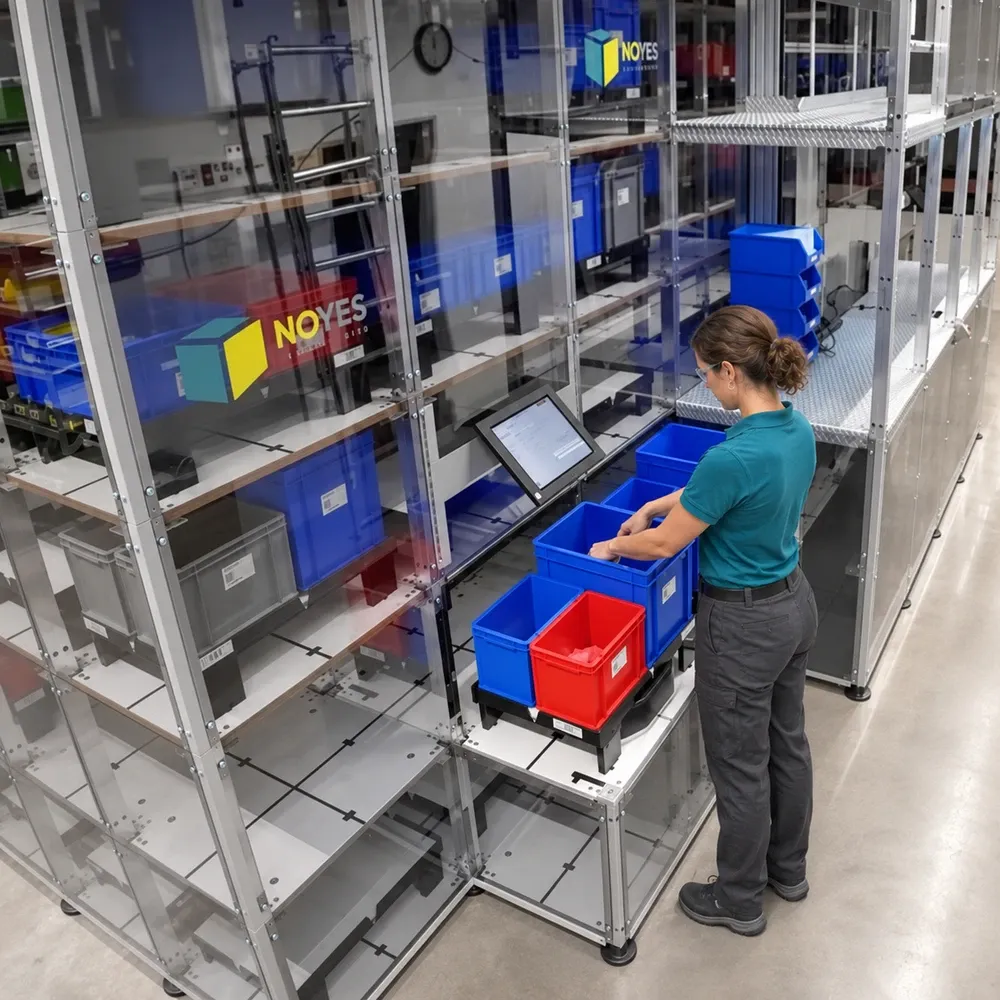
Our comparison image shows two working situations. On the left, a worker has to bend down to retrieve an item from a low shelf. On the right, an employee stands in front of the NoyesStorage picking balconies and accesses the containers presented there. Goods arrive at a defined handover point while the NoyesElevator connects the levels within the system.
This raises a practical question: does your team have to adapt to the storage location of every item, or can goods be presented in a way that suits the people handling them? Improving order picking means looking beyond pick rates and walking distances. Picking height, reach, and the next step after retrieval matter too. This article explains what to consider and which improvements you can make in an existing warehouse.
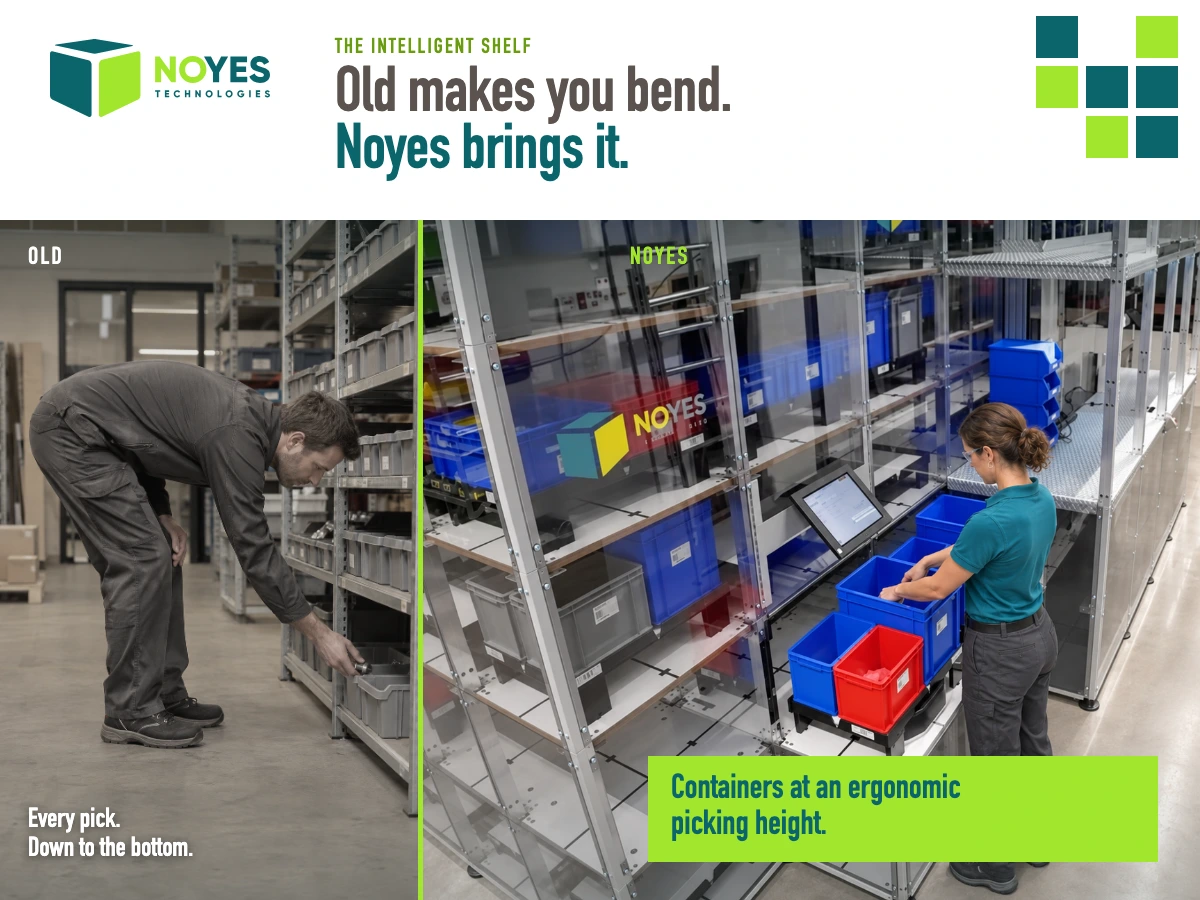
AI-generated illustration comparing manual retrieval from a low shelf with container presentation at a picking balcony.
Why warehouse ergonomics starts with each pick
Order picking means collecting items for an order. In practice, it consists of many individual tasks: walking, searching, reaching, retrieving, placing, and confirming. An awkward movement can be part of an otherwise well-organized process.
Assessing manual order picking therefore requires more than identifying the heaviest container. The frequency of retrieval, body posture, and duration of a task also matter. Germany’s Federal Institute for Occupational Safety and Health (BAuA) provides Key Indicator Methods for systematically assessing different types of physical workload. Source: BAuA, Key Indicator Methods.
Start by following a complete order through the warehouse. Where does the person lean far forward? Where do they reach above shoulder height? Where is a container lifted even though its contents could be picked directly from the presentation point? These observations provide concrete starting points for workplace design.
Include replenishment and packing in your assessment. A well-designed picking station only solves part of the problem if completed order containers then have to be placed on the floor.
Picking height and reach: what makes a good picking station?
Assess the height of the actual retrieval point
The top of a balcony or worktable does not tell you where the hand reaches to retrieve an item. In a tall container, the last few small parts may sit much lower than the first. When choosing storage equipment, test retrieval from both full and nearly empty containers.
A suitable working height depends on the dimensions of the people using the station and the task itself. Fine manual tasks may require different conditions from moving heavy objects. A single measurement would therefore be too simplistic as a universal recommendation. BAuA’s workplace design guidance considers the point where the task is performed, reach zones, and body dimensions. Source: BAuA, physical workload and workplace design.
Keep frequently used items within easy reach
Even at a suitable height, a container can be too far away. If someone has to reach over the front row, the working situation remains awkward. Frequently used objects should therefore be positioned within an easily accessible reach zone. Source: BAuA, workplace design.
Test the station with the containers and items you actually use. Can shorter and taller team members reach the goods? Is there enough room for their feet in front of the balcony? Can they access the scanner, display, and order container without twisting their upper body for every pick?
You can test these questions early in the planning process. In a BGHM case example, employees helped redesign a workplace and tested its dimensions using a cardboard model. The changes reduced lifting operations and enabled more transfers at the same height. Source: BGHM, order picking case example.
Goods-to-person picking: separate storage height from access
With conventional shelving, an item’s storage location determines where a person needs to go. Goods-to-person picking changes this process: the system transports the required goods to a presentation point. Retrieval can then take place separately from the storage location itself.
An automated small-parts warehouse can use storage locations on different levels while the team picks at a designated workstation. From an ergonomics perspective, the design of that station and the handover to the next task are what matter.
How access works with NoyesStorage
In a NoyesStorage system equipped with NoyesElevator, the elevator connects the levels in the background. The picking balconies remain at an ergonomic picking height. The employee stands in the aisle in front of the balconies and retrieves items from the containers presented there. Our NoyesElevator product information describes this function too.
The balconies provide accessible handover points at the front of the system. The person does not need to step inside the system or follow a container to a higher storage level to pick an item. This is the arrangement shown in the revised illustration.
When planning, distinguish clearly between container transport and item retrieval. Automated order picking can combine automated presentation with manual tasks. In the NoyesStorage process described here, the equipment transports the containers and the team retrieves individual items. This does not imply robotic picking of individual parts.
A suitable presentation height also does not replace the need to assess container depth, reaching distances, and suitability for people of different heights. The height at which picked items are placed belongs in the workstation design as well.
Improve order picking: five steps for your warehouse
1. Identify repeated movements
Observe typical orders as well as peak periods. Record which items involve deep bending, long reaches, or additional lifting. Involve the warehouse team: they also know the exceptions that a short walk-through can easily miss.
2. Improve frequent retrievals in existing shelving
Check whether frequently picked items are stored in awkward locations. Changing slotting, using smaller containers, or introducing suitable lifting and transport aids may provide useful starting points. Consider weight and retrieval frequency together rather than allocating items solely according to available shelf space.
3. Consider the complete material flow at the workstation
Follow an item from replenishment to packing. Where does it move between different heights? Where is a container handled twice? Use a sample order to test presentation, retrieval, confirmation, and placement as one connected process.
4. Match warehouse automation to the specific problem
Compare solutions using your items, containers, orders, and available space. Ask specifically about the workstation in front of the system: what does a normal pick look like? How does replenishment work? What happens with an unusually heavy or bulky item? This helps you assess where warehouse automation can usefully change the process.
5. Review the change
Assess comparable tasks before and after the change. Alongside order throughput, useful observations include the number of low-level retrievals, additional container lifts, and feedback on accessibility. The relevant Key Indicator Methods can support a professional assessment of physical workload. Source: BAuA, Key Indicator Methods.
Plan for task variety and movement too. A workstation that reduces walking should still allow varied activities. The aim is a well-designed workflow throughout the shift.
Frequently asked questions about ergonomic order picking
Is there one ideal picking height for everyone?
A suitable picking height depends on body height, the task, and container design. The actual retrieval point matters, including when a container is nearly empty. Test the station with the people and items it is intended for. Source: BAuA, workplace design.
Can manual order picking be designed ergonomically?
Yes. Item placement, suitable containers, short reaches, and appropriate handling aids all offer starting points. Where many repeated transports and retrievals at different heights occur, it is also worth comparing these arrangements with automated presentation. The measures that fit depend on the specific task.
Does an automated small-parts warehouse make every pick ergonomic?
Automated presentation creates opportunities for a suitable workstation. Its quality still depends on the details: reach distance, container weight, movement space, scanner position, and placement area need to work together. Always assess the complete workflow at the system.
Assess your next picking station
Take these three questions into your planning:
- Where does retrieval actually take place? Assess the goods inside the container, not just the height of its support.
- How does the person reach the item? Short reaches and enough movement space belong in the design.
- What happens after retrieval? Order containers and packing need to fit the workstation too.
Would you like to explore a more ergonomic warehouse setup? Talk to us about your containers, retrieval tasks, and available space. Together, we can assess how NoyesStorage and container presentation at the picking balconies could fit your workflow.